A Guide for Artists

Selling Your Prints Online

The platforms worth your time in 2026, six practical habits that work on any of them, and the full story of one of our own artists — from rock drummer to a hundred thousand followers.

Build work worth following, share it honestly and consistently, and the audience finds you.
The Short Version
Why this page exists

The rules have changed. The principles haven't.

Selling art online in 2026 looks nothing like it did in 2015. Facebook has quietly ceased to matter for most fine art discovery. Instagram is still where collectors browse, but TikTok, Pinterest and YouTube now play roles they simply didn't five years ago.

What hasn't changed is the underlying craft: producing work worth following, showing your process, turning up consistently, and treating the people who buy from you as more than just a transaction.

This page is a short, honest guide to the platforms worth your time, the habits that actually move the needle, and the story of one artist who has done it — a former rock drummer we've been printing for more than ten years.

The Platform Landscape

Five places your art can find an audience

Pick one or two and commit to them. Trying to be everywhere tends to mean being nowhere convincingly.

Still the hub for fine art

Instagram

Instagram remains the strongest sales engine for fine art. Reels drive discovery, grid posts build your portfolio, and the Shop feature lets you tag products. Strong across fine art, illustration, photography and craft. The place to build first.

  • Reels are currently the strongest growth lever
  • Mix finished work, process, studio life
  • Post 3–5 times per week, daily Stories
  • Audience skews 25–44, well distributed globally
Wide, engaged
For viral discovery

TikTok

The fastest route to reach people who've never heard of you. The discovery algorithm rewards creativity over follower count — a single time-lapse of a painting in progress can put unknown work in front of millions. Best for process-led content.

  • Short, honest, well-hooked videos win
  • Time-lapses, studio tours, material reveals
  • Post daily if you can manage it
  • Audience skews younger (18–34)
Young, global
For buyers with intent

Pinterest

The most underrated platform for artists. Not a social network — a visual search engine. Users actively search for art for their homes, which means traffic Pinterest sends you is closer to purchase than any other platform. Content stays discoverable for years.

  • Evergreen — pins keep working for months
  • Link each pin straight to your shop
  • Post 5–10 pins per day, mostly batch-scheduled
  • Audience skews female, 25–55, high intent
High purchase intent
For evergreen reach

YouTube

Two platforms in one. Shorts compete for discovery with TikTok and Reels. Long-form tutorials and studio vlogs build deep audience trust and, crucially, keep earning — a well-made tutorial can bring in new followers and sales for years after it was uploaded.

  • Shorts for discovery, long-form for trust
  • Tutorials, studio tours, technique breakdowns
  • Content has the longest shelf life of any platform
  • Monetisation available at 1,000 subscribers
All demographics
For community, not discovery

Facebook

Honestly? Facebook's role in art discovery has fallen sharply over the last decade, and for most fine art artists it no longer justifies the effort by itself. Where it still works is Groups (niche communities), Marketplace (local sales), and Messenger (direct conversations with existing collectors).

  • Groups are where Facebook still earns its keep
  • Marketplace works for local print sales
  • Audience skews 45+
  • Low priority if you're starting fresh
Older, community-led
The Design Principle
“The algorithm rewards what you'd want to watch anyway. Don't perform for the machine — show up often enough that strangers become friends.”
A useful rule of thumb
What Actually Works

Six habits, whichever platform you pick

Choose one or two of the platforms above and make these six habits part of the routine. They transfer across every platform and they age well.

1

Post consistently, not constantly

Three considered posts a week, every week, will do more for your reach than ten frantic ones followed by silence. Algorithms reward reliability. So do audiences — people follow artists whose work they trust will show up in their feed.

2

Mix finished work with process

Finished pieces are the work. Process — the studio floor, a half-painted panel, a palette mid-mix, the frustrating bits — is the story. Audiences buy the story long before they buy a piece. Show both, and the sales follow.

3

Build an email list from day one

Social platforms change the rules on you without warning. An email list is the one audience that's genuinely yours — no algorithm, no throttling, direct to their inbox. Even a few hundred engaged subscribers outperforms tens of thousands of passive followers.

4

Use in-room mockups for every listing

A flat image of a print floating on white sells badly. The same print shown hanging above a sofa sells significantly better — scale, context and the flicker of "I could live with this" do most of the persuasion. We've written a separate guide to mockup tools.

5

Cross-post efficiently, not identically

Make content once, adapt it three ways. A single studio video can become a Reel, a TikTok, a Pinterest pin and a YouTube Short — each reformatted to the platform's conventions. That's leverage. Posting the same file everywhere with no adjustment is not.

6

Make buying frictionless

Every post should answer the question "how do I buy this?" in under three taps. Link in bio, pinned comment, Shop tag, story sticker — whatever the platform gives you, use it. If people have to hunt to buy, most won't.

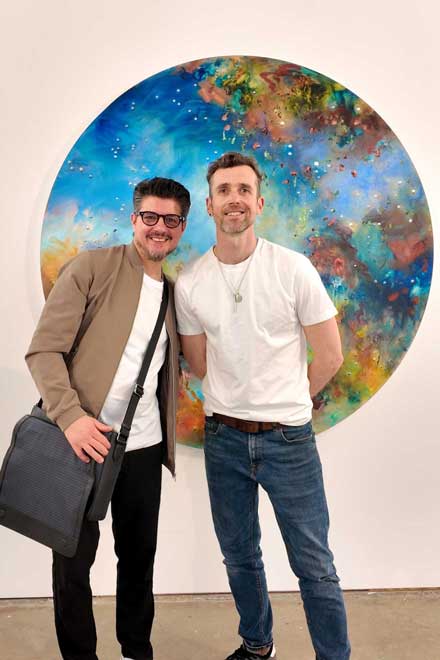
Thomas Chard with artist Chris Rivers in front of a large circular painting at Pontone Gallery, London.
Thomas with Chris Rivers during the install of Supernova Part 2 at Pontone Gallery, London — April 2026.
From Our Artists

From drumsticks to 100,000 followers

Chris Rivers spent a decade touring the world as the drummer for UK rock band Heaven's Basement. On a four-month American tour in 2013, he started sketching on his used drumheads with Sharpie pens after shows. The sketching quickly became the point. Within a few years he'd stepped away from music entirely and committed to painting full-time — teaching himself as he went, building a body of work, and documenting every stage of the journey on Instagram.

Ten years on, he has a hundred thousand Instagram followers, is represented by Pontone Gallery in London (and in Wynwood, Miami), and has been featured in Forbes. His current solo exhibition at Pontone — Supernova Part 2 — is a series of new works looking back across those ten years, revisiting old eras and new ideas in equal measure. Ten years earlier, he was on a tour bus, sketching on his used drumheads with a Sharpie.

We've been printing Chris's work for more than ten years — well before his first solo show. His giclée fine art prints are produced on two papers he's arrived at through experimentation: Arches Aquarelle Rag for the saturated cotton depth, and Hahnemühle's sustainable Agave for its natural-fibre tooth.

“There's no right or wrong way with anything creative. I enjoy the process of trial and error and learning things for yourself — same mentality as I had playing drums.”
— Chris Rivers

What his story captures — and what most artists starting out don't quite believe — is that the old gallery-first career path isn't the only route. Build work worth following, share it honestly and consistently, and the right audience finds you. The galleries come after.
Before the first post

Start with a print worth selling

No feed, algorithm or audience rescues a mediocre print. If you're going to ask strangers to buy your work online, the paper, the inks and the finishing are what they'll eventually unbox and live with — and that part happens in the studio, not on screen. It's what we've been helping artists get right since 1982.

Questions? Give us a call 0117 952 0105